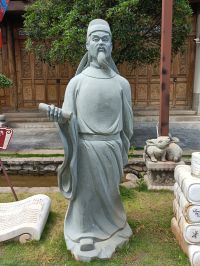
Summary

Portrait of Fan Chuo Fan Chuo,  Translation:Manshu — Chapter 7

“ Traditionally the bark is harvested in March to May. The active ingredient, berberine, was supposedly used in China as a folk medicine by Shennong around 3000BCE according to The Classic of Herbal Medicine (神農本草經) , a lost book of herbal knowledge believed to be compiled from oral traditions around 200-250CE. There are two species: Phellodendron amurense is from north-eastern China and was probably the more common point of reference for Chinese like our author. That said, Phellodendron chinense grows in the Yunnan region and may have been known from Sichuan. ”
Source: Wikisource

Portrait of Fan Chuo Fan Chuo,  Translation:Manshu — Chapter 7

“ Proto-Sino-Tibetan: *Krij (Tibetan: gri — knife) Proto-Austro-Asiatic: *kat / *ka:t (cut — Thai: khat (to split) — Khmer: kat (cut) — Khasi: dkhat (to break off, snap) ) 雲 yún (Middle Chinese: hjun) Nuosu Yi ꒃ (pick up) Nuosu Yi ꑻ (people) 孚 fú​ (Middle Chinese: /phɨo/) dak t͡ʃiɪp̚ / duó​jí​ (鐸戢) — Almost certainly an Yi word. Begins with the same phonetic transliteration as other, high-evidence knife-related semantic compounds, and trailing qualifier matches language structure. 鐸 duó​ (Middle Chinese: dak) Nuosu Yi ꅅꃅ ddox (do34) — probably a word root meaning knife or knife-like blade. ”
Source: Wikisource

Portrait of Fan Chuo Fan Chuo,  Translation:Manshu — Chapter 7

“ Given that there are suggestions he journeyed to both Sichuan and Annam, one may assume that either jackfruit is not endemic to Annam (it is surely popular these days) or he wrote this section whilst in Sichuan, prior to arriving in Annam.↑ In my interpretation, the author is afraid that accusations will be raised that he spent his time eating the local delicacies instead of performing his bureaucratic duties!↑ See note #115, chapter 2. ”
Source: Wikisource

Get perspective with Kwize: daily news enlightened by great literature