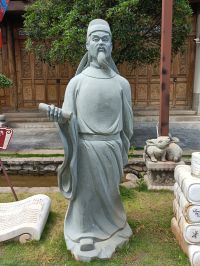
Fan Chuo

Biographical details

Portrait of Fan Chuo Fan Chuo,  Translation:Manshu — Chapter 4

“ Rationale is as follows: historically the character 羌 was used not to denote a modern ethnic identification, but "the term 'Qiang' denoted only non-Han people living in the upper Min River Valley and Beichuan area, the area now occupied by the modern Qiang." (Wikipedia, Wikipedia) . The prefix 大 (meaning large/great) is often used for reasonable sized empires or political confederations. It would feel a more tortured interpretation in this list to include the two characters 大羌 within the name of the individual, particularly given the nominal title-like prefix already commonly present, 楊. ”
Source: Wikisource

Portrait of Fan Chuo Fan Chuo,  Translation:Manshu

“ The Yi were both powerful and independent until after the Yuan Dynasty when their princess made a deal with the invading Mongols. They wore impressive armour, examples of which can be seen online here at Sichuan University Museum and here at Harvard, or in person at the Anthropology Museum of Yunnan University on Beimenjie in Kunming. ”
Source: Wikisource

Portrait of Fan Chuo Fan Chuo,  Translation:Manshu — Chapter 3

“ When I read this I had a suspicion, purely from the relative geography and topography, that this could refer to the precipice-laden area around modern Dàjù (大具) at the north-eastern end of Tiger Leaping Gorge (虎跳峡) , though this was by no means a positive identification and could potentially refer to a large number of relatively disconnected (ie. suitable for use as a hideout) locations in the region with an exposed cliff face. As a confident interpretation of the text emerges this relatively random guess may be possible to revise, and indeed already looks highly unlikely. ”
Source: Wikisource

Get perspective with Kwize: daily news enlightened by great literature