Summary

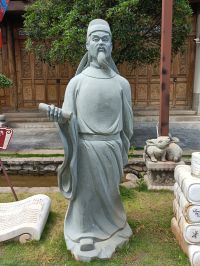
Portrait of Fan Chuo Fan Chuo,  Translation:Manshu — Chapter 2

“ It is interesting to note, given the early period in history discussed, that Confucius (551–479 BCE) was from Qufu in Shandong (山东曲阜) , which is virtually the opposite side of China, and that Zhugeliang hailed from the same region, a mere 50km to the east of Qufu in modern Yinan county (沂南县) .↑ The character {曰鬥} is of unknown pronunciation but presumably refers in its initial radical 「曰」to 'speech' or rather the idea of the creation of noise, and in its latter 「鬥」 ("gate" or "pass") radical to the a river passing betwixt a deep or tight gorge. ”
Source: Wikisource

Portrait of Fan Chuo Fan Chuo,  Translation:Manshu — Chapter 2

“ No other interpretation presents itself as meaningful in context.↑ The initial component of 金马碧鸡 (lit. "Golden Horse [Mountain] [and] Jade Chicken [Mountain] ") referring to the west and east mountains on either side of Kunming, said to be facing one another, and named according to legend explained in the previous chapter of this translation.↑ The specification of this (north-eastern side of the eastern range) as the water source is interesting, though probably not entirely accurate as the watershed obviously includes all sides of the lake-valley plateau. ”
Source: Wikisource

Portrait of Fan Chuo Fan Chuo,  Translation:Manshu — Chapter 2

“ Shāng​làng​ (湯浪) is located where the current slows." however this seems less likely to me (though do not hold this opinion up as unassailable, by any means!) for a few reasons: (1) There is no precedent for discussing a particular location, rather the established context is a range of locations either side of the mountains. (2) The use of 也 is (to my inexperienced eyes) a classical Chinese flourish in this later-period text which alludes to the elevation of the prior phrase to literary modes of interpretation (note that Shāng​làng​ (湯浪) quite possibly rhymed in the Tang Dynasty) . ”
Source: Wikisource

Get perspective with Kwize: daily news enlightened by great literature