Summary

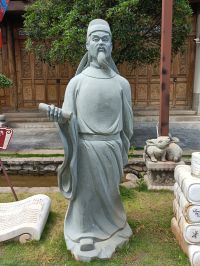
Portrait of Fan Chuo Fan Chuo,  Translation:Manshu — Chapter 4

“ Architecture Original Translation 凡人家所居,皆依傍四山,上棟下宇,悉與漢同,惟東西南北,不取周正耳。 Regarding the ordinary people's houses, they are always constructed similarly to four ‘山’ characters, with a high ridgepole and lower eaves. They are very similar to Han Chinese houses, but always face north-south-east-west and as such do not properly accord with their endemic environs. [18] 別置倉舍,有欄檻,腳高數丈,雲避田鼠也,上閣如車蓋狀。 Barns are separate to residences, and are fenced-off. They are a few zhàng​ (ie. about 10 meters) in height, the upper portion being resistant to rodents, and resembling vehicles in their manner of covering. ”
Source: Wikisource

Portrait of Fan Chuo Fan Chuo,  Translation:Manshu — Chapter 4

“ Rationale is as follows: historically the character 羌 was used not to denote a modern ethnic identification, but "the term 'Qiang' denoted only non-Han people living in the upper Min River Valley and Beichuan area, the area now occupied by the modern Qiang." (Wikipedia, Wikipedia) . The prefix 大 (meaning large/great) is often used for reasonable sized empires or political confederations. It would feel a more tortured interpretation in this list to include the two characters 大羌 within the name of the individual, particularly given the nominal title-like prefix already commonly present, 楊. ”
Source: Wikisource

Portrait of Fan Chuo Fan Chuo,  Translation:Manshu — Chapter 4

“ The thousand-year period, often referred to as the Pyu millennium, linked the Bronze Age to the beginning of the classical states period when the Pagan Kingdom emerged in the late 9th century. The city-states—five major walled cities and several smaller towns have been excavated—were all located in the three main irrigated regions of Upper Burma: the Mu River Valley, the Kyaukse plains and Minbu region, around the confluence of the Irrawaddy and Chindwin Rivers. Part of an overland trade route between China and India, the Pyu realm gradually expanded south. ”
Source: Wikisource

Get perspective with Kwize: daily news enlightened by great literature