Summary

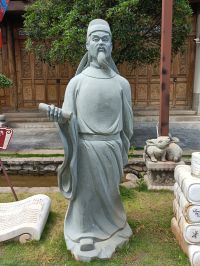
Portrait of Fan Chuo Fan Chuo,  Translation:Manshu — Chapter 3

“ When I read this I had a suspicion, purely from the relative geography and topography, that this could refer to the precipice-laden area around modern Dàjù (大具) at the north-eastern end of Tiger Leaping Gorge (虎跳峡) , though this was by no means a positive identification and could potentially refer to a large number of relatively disconnected (ie. suitable for use as a hideout) locations in the region with an exposed cliff face. As a confident interpretation of the text emerges this relatively random guess may be possible to revise, and indeed already looks highly unlikely. ”
Source: Wikisource

Portrait of Fan Chuo Fan Chuo,  Translation:Manshu — Chapter 3

“ This is interesting given the context, possibly emphasizing learnedness with regard to Chinese language and custom versus barbarian ways.↑ Earthen burials could be argued to be one of the defining characteristics of Chinese civilization. Not all of the non-Chinese peoples of the region under discussion necessarily buried their dead, though some did bury their nobility, for example the pre-Chinese Shu Kingdom of Sichuan. ”
Source: Wikisource

Portrait of Fan Chuo Fan Chuo,  Translation:Manshu — Chapter 3

“ According to this Baidu Baike entry, Shenchuan has been identified by scholars as option one — the upper Yangtse valley itself — and in context, we can safely further limit that identification to areas upstream from Tiger Leaping Gorge (虎跳峡) .↑ One could assume that these two towns were likely to have been those along the more eastern portion of the river valley, ie. closer to Tiger Leaping Gorge (虎跳峡) . ”
Source: Wikisource

Get perspective with Kwize: daily news enlightened by great literature