Summary

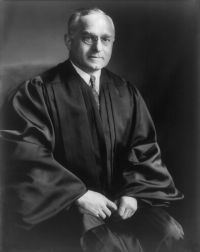
Portrait of Felix Frankfurter Felix Frankfurter Thomas Paper Stock Company v. Porter…

The giving of free reign to inflationary pressure was likely to endanger seriously our economy and to bring great hardship to many individuals. I cannot, without a clear declaration to that effect with respect to any part of our economy, impute to Congress an intent to let inflation run riot during such critical times. I cannot conclude, therefore, as the opinion of the Court necessarily does, that Congress intended to suspend all Maximum Price Regulations containing standardization provisions until the Price Administrator reviewed them.
Source: Wikisource

Portrait of Felix Frankfurter Felix Frankfurter Thomas Paper Stock Company v. Porter…

That Regulation establishes dollar and cent ceiling prices for thirty-two grades of wastepaper defined by the Price Administrator. It is the type of regulation, of which there have been many, which controls prices by first standardizing or grouping similar commodities, and then fixing one and the same maximum price for each of the commodities in a particular classification. On July 16, 1943, long after Regulation No. 30 was promulgated and fully in force, Congress added the Taft Amendment, (Section 2 (j) to the Emergency Price Control Act of 1942.
Source: Wikisource

Portrait of Felix Frankfurter Felix Frankfurter Thomas Paper Stock Company v. Porter…

But Congress did not sanction standardization for what we may deem a reasonable period after the enactment of the Taft Amendment without the Administrator's determination of its need.
This is too substantial a qualification to be made by judicial interpolation. Nor can we draw on broad arguments about inflationary pressures on price control in construing legislation dealing with so technically confining a provision as that of the Taft Amendment.
Source: Wikisource

Get perspective with Kwize: daily news enlightened by great literature