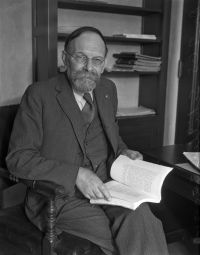
Ferdinand Canning Scott Schiller

Ferdinand Canning Scott Schiller

Summary

Portrait of Ferdinand Canning Scott Schiller Ferdinand Canning Scott Schiller Riddles of the Sphinx (1891)

And here the author admits that we come upon the trace of the teleology which is inseparable from all evolution. “For when the phenomena of the world’s evolution are subordinated to the general law of evolution, their relation inevitably tends to become that of a means to an end.” This he contends is not the teleology which is dreaded by the modern exponents of natural science. It does not attempt to regard all creation as existing for the use and benefit of man.
Source: Wikisource

Portrait of Ferdinand Canning Scott Schiller Ferdinand Canning Scott Schiller Riddles of the Sphinx (1891)

It is here, then, the writer brings forward his own method, which is the basing of metaphysics on science—they must be concrete, and not abstract. “In other words, they must proceed from the phenomenally real to the ultimately real, from science to metaphysics.” Where he differs from current evolutionary philosophy in determining the relation of the higher to the lower, is that, whereas the popular philosophy now endeavours to interpret the higher by the lower, this writer would have us interpret the lower by the higher—that things have had a history is the basis of the evolutionary philosophy
Source: Wikisource

Portrait of Ferdinand Canning Scott Schiller Ferdinand Canning Scott Schiller Riddles of the Sphinx (1891)

He has begun, but he has not ended the philosophy of Evolution.” While admitting the truth of Mr. Spencer’s formula, he insists that it is not all the truth, and the same with Von Hartmann’s. As to his own conclusion, the author gives what is rather an illustration than a formula, though he uses it as the latter. “All real progress develops both the individual and the social medium. It is a development of the individual in society, and of society through the individual.”
Source: Wikisource

Get perspective with Kwize: daily news enlightened by great literature