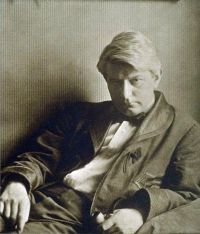
Frank Norris

Frank Norris

Summary

Portrait of Frank Norris Frank Norris McTeague — Chapter 20 (1899)

At noon, after he had been tramping for some two hours, he halted at a point where the road dipped suddenly. A little to the right of him, and flanking the road, an enormous yellow gravel-pit like an emptied lake gaped to heaven. Farther on, in the distance, a canyon zigzagged toward the horizon, rugged with pine-clad mountain crests. Nearer at hand, and directly in the line of the road, was an irregular cluster of unpainted cabins. A dull, prolonged roar vibrated in the air. McTeague nodded his head as if satisfied.
Source: Wikisource

Portrait of Frank Norris Frank Norris McTeague — Chapter 20 (1899)

Then one could hear the noises that the mountains made in their living. From the canyon, from the crowding crests, from the whole immense landscape, there rose a steady and prolonged sound, coming from all sides at once. It was that incessant and muffled roar which disengages itself from all vast bodies, from oceans, from cities, from forests, from sleeping armies, and which is like the breathing of an infinitely great monster, alive, palpitating.
McTeague returned to his work. At six in the morning his shift was taken off, and he went out of the mine and back to the bunk house.
Source: Wikisource

Portrait of Frank Norris Frank Norris McTeague — Chapter 20 (1899)

The night was warm and still; the moon, very low, and canted on her side like a galleon foundering. The camp was very quiet; nobody was in sight. "I wonder what it was," muttered the dentist. "There was something--why did I wake up? Huh?" He made a circuit about the bunk house, unusually alert, his small eyes twinkling rapidly, seeing everything. All was quiet. An old dog who invariably slept on the steps of the bunk house had not even wakened. McTeague went back to bed, but did not sleep.
Source: Wikisource

Get perspective with Kwize: daily news enlightened by great literature