Summary

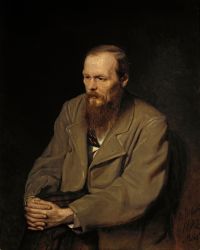
Portrait of Fyodor Dostoevsky Fyodor Dostoevsky The Brothers Karamazov — Part IV, Book X, Chapter 5 (1880)

Kolya said suddenly, in a most callous voice.
"Ye-es," answered Ilusha in a long whisper, gasping for breath.
"A black nose, that means he'll be fierce, a good house-dog," Kolya observed gravely and stolidly, as if the only thing he cared about was the puppy and its black nose. But in reality he still had to do his utmost to control his feelings not to burst out crying like a child, and do what he would he could not control it. "When it grows up, you'll have to keep it on the chain, I'm sure."
"He'll be a huge dog!" cried one of the boys.
Source: Wikisource

Portrait of Fyodor Dostoevsky Fyodor Dostoevsky The Brothers Karamazov — Part IV, Book X, Chapter 5 (1880)

He might well squeal, because the skin of dogs' mouths is so tender... tenderer than in men, much tenderer!" Kolya cried impetuously, his face glowing and radiant with delight. Ilusha could not speak. White as a sheet, he gazed open-mouthed at Kolya, with his great eyes almost starting out of his head. And if Krassotkin, who had no suspicion of it, had known what a disastrous and fatal effect such a moment might have on the sick child's health, nothing would have induced him to play such a trick on him. But Alyosha was perhaps the only person in the room who realised it.
Source: Wikisource

Portrait of Fyodor Dostoevsky Fyodor Dostoevsky The Brothers Karamazov — Part IV, Book X, Chapter 5 (1880)

Smurov put in suddenly, proud of Krassotkin at such a moment. He was particularly pleased with the story of the goose.
"Did you really take him down?" the captain inquired, in a flattering way. "On the question who founded Troy? We heard of it, Ilusha told me about it at the time."
"He knows everything, father, he knows more than any of us!" put in Ilusha; "he only pretends to be like that, but really he is top in every subject..."
Ilusha looked at Kolya with infinite happiness.
Source: Wikisource

Get perspective with Kwize: daily news enlightened by great literature