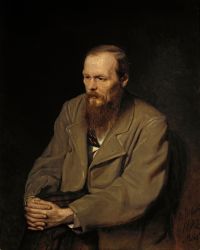
Fyodor Dostoevsky

Fyodor Dostoevsky

The Idiot — Part III/Chapter VIII (1913<!--year of translation-->)

Summary

Portrait of Fyodor Dostoevsky Fyodor Dostoevsky,  The Idiot — Part III/Chapter VIII (1913<!--year of translation-->)

“ I suppose you imagine yourself a field-marshal, and think you have conquered Napoleon?"
"Well, I really have thought something of the sort now and then, especially when just dozing off," laughed the prince. "Only it is the Austrians whom I conquer—not Napoleon."
"I don't wish to joke with you, Lef Nicolaievitch. I shall see Hippolyte myself. Tell him so. As for you, I think you are behaving very badly, because it is not right to judge a man's soul as you are judging Hippolyte's. You have no gentleness, but only justice—so you are unjust."
”
Source: Wikisource

Portrait of Fyodor Dostoevsky Fyodor Dostoevsky,  The Idiot — Part III/Chapter VIII (1913<!--year of translation-->)

“ The prince reflected.
"I think you are unfair towards me," he said. "There is nothing wrong in the thoughts I ascribe to Hippolyte; they are only natural. But of course I don't know for certain what he thought. Perhaps he thought nothing, but simply longed to see human faces once more, and to hear human praise and feel human affection. Who knows? Only it all came out wrong, somehow. Some people have luck, and everything comes out right with them; others have none, and never a thing turns out fortunately."
"I suppose you have felt that in your own case," said Aglaya.
”
Source: Wikisource

Portrait of Fyodor Dostoevsky Fyodor Dostoevsky,  The Idiot — Part III/Chapter VIII (1913<!--year of translation-->)

“ Yesterday evening you sprang forward to protect her, and just now you dreamed about her. You see, I know all. You did come back here for her, for her—now didn't you?"
"Yes—for her!" said the prince softly and sadly, and bending his head down, quite unconscious of the fact that Aglaya was gazing at him with eyes which burned like live coals. "I came to find out something—I don't believe in her future happiness as Rogojin's wife, although—in a word, I did not know how to help her or what to do for her—but I came, on the chance."
”
Source: Wikisource

Get perspective with Kwize: daily news enlightened by great literature