Fyodor Dostoevsky

Fyodor Dostoevsky

The Idiot — Part IV/Chapter VIII (1913<!--year of translation-->)

Summary

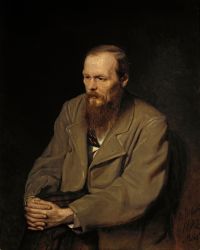
Portrait of Fyodor Dostoevsky Fyodor Dostoevsky,  The Idiot — Part IV/Chapter VIII (1913<!--year of translation-->)

“ I despise you when you speak of toil."
"If you had cared to be an honest woman, you would have gone out as a laundress."
Both had risen, and were gazing at one another with pallid faces.
"Aglaya, don't! This is unfair," cried the prince, deeply distressed.
Rogojin was not smiling now; he sat and listened with folded arms, and lips tight compressed.
"There, look at her," cried Nastasia, trembling with passion. "Look at this young lady! And I imagined her an angel! Did you come to me without your governess, Aglaya Ivanovna? Oh, fie, now shall I just tell you why you came here today?
”
Source: Wikisource

Portrait of Fyodor Dostoevsky Fyodor Dostoevsky,  The Idiot — Part IV/Chapter VIII (1913<!--year of translation-->)

“ Suddenly she looked around, shuddered, gave a loud cry, and threw herself in the prince's arms.
"Mine, mine!" she cried. "Has the proud young lady gone? Ha, ha, ha!" she laughed hysterically. "And I had given him up to her! Why—why did I? Mad—mad! Get away, Rogojin! Ha, ha, ha!"
Rogojin stared intently at them; then he took his hat, and without a word, left the room.
A few moments later, the prince was seated by Nastasia on the sofa, gazing into her eyes and stroking her face and hair, as he would a little child's. He laughed when she laughed, and was ready to cry when she cried.
”
Source: Wikisource

Portrait of Fyodor Dostoevsky Fyodor Dostoevsky,  The Idiot — Part IV/Chapter VIII (1913<!--year of translation-->)

“ The prince felt sure that Nastasia would say nothing about the letters herself; but he could judge by her flashing eyes and the expression of her face what the thought of those letters must be costing her at this moment. He would have given half his life to prevent Aglaya from speaking of them. But Aglaya suddenly braced herself up, and seemed to master herself fully, all in an instant.
"You have not quite understood," she said. "I did not come to quarrel with you, though I do not like you. I came to speak to you as... as one human being to another.
”
Source: Wikisource

Get perspective with Kwize: daily news enlightened by great literature