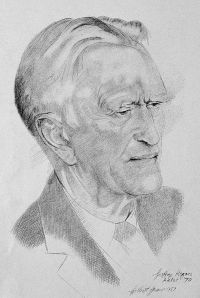
Geoffrey Keynes

Geoffrey Keynes

Summary

Portrait of Geoffrey Keynes Geoffrey Keynes Blood Transfusion

During the war, even when transfusion was being practised on a large scale, there was never any difficulty in finding volunteers among the men that were more lightly wounded. In addition to the genuine and ready response which many men would make at once to a call for help in a matter of life and death, there was the glamour of novelty and the feeling of satisfaction following an act of conscious heroism—for such the sacrifice of blood was held to be, the days having long been forgotten when as much blood was “let” in the treatment of almost any ailment.
Source: Gutenberg

Portrait of Geoffrey Keynes Geoffrey Keynes Blood Transfusion

Notoriety is fortunately seldom a motive for volunteering, and though paragraphs have occasionally appeared in the daily press with headings such as “Police Inspector’s Sacrifice,” this has probably not been done by the donor’s own wish. It is, after all, natural that to the mind of a layman the giving to another of so personal a possession as his blood should seem to be an act of heroism, and it is also natural that occasionally a man should feel some repugnance to taking part in a strange performance which he but dimly understands.
Source: Gutenberg

Portrait of Geoffrey Keynes Geoffrey Keynes Blood Transfusion

In the seventeenth century a happy ignorance took no account of them whatever. In the eighteenth century they were so greatly feared that transfusion fell into abeyance. In the nineteenth century it was realized that dangers existed, but they were imperfectly understood; when fatalities occurred, a partial knowledge explained them away more easily than our fuller knowledge can to-day, so that transfusion was practised in spite of them. At the beginning of the twentieth century, with the discovery of “blood groups,” it was thought that all danger had been eliminated.
Source: Gutenberg

Get perspective with Kwize: daily news enlightened by great literature