Summary

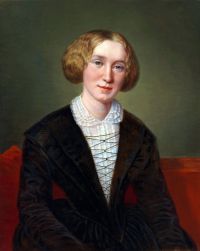
Portrait of George Eliot George Eliot The Mill on the Floss — Book 1… (1860)

If a man means to be hard, let him keep in his saddle and speak from that height, above the level of pleading eyes, and with the command of a distant horizon. Mrs. Moss heard the sound of the horse's feet, and, when her brother rode up, was already outside the kitchen door, with a half-weary smile on her face, and a black-eyed baby in her arms. Mrs. Moss's face bore a faded resemblance to her brother's; baby's little fat hand, pressed against her cheek, seemed to show more strikingly that the cheek was faded.
Source: Wikisource

Portrait of George Eliot George Eliot The Mill on the Floss — Book 1… (1860)

Mrs. Moss went on, looking at her children with a didactic purpose. But she turned toward her brother again to say, "Not but what I hope your boy 'ull allays be good to his sister, though there's but two of 'em, like you and me, brother."
The arrow went straight to Mr. Tulliver's heart. He had not a rapid imagination, but the thought of Maggie was very near to him, and he was not long in seeing his relation to his own sister side by side with Tom's relation to Maggie. Would the little wench ever be poorly off, and Tom rather hard upon her?
Source: Wikisource

Portrait of George Eliot George Eliot The Mill on the Floss — Book 1… (1860)

Glegg her loan of five hundred pounds, it naturally occurred to him that he had a promissory note for three hundred pounds lent to his brother-in-law Moss; and if the said brother-in-law could manage to pay in the money within a given time, it would go far to lessen the fallacious air of inconvenience which Mr. Tulliver's spirited step might have worn in the eyes of weak people who require to know precisely how a thing is to be done before they are strongly confident that it will be easy.
Source: Wikisource

Get perspective with Kwize: daily news enlightened by great literature