Summary

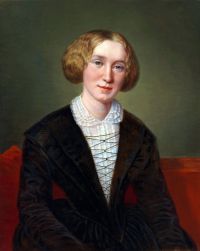
Portrait of George Eliot George Eliot The Mill on the Floss — Book 1… (1860)

At last, however, the green fields came to an end, and Maggie found herself looking through the bars of a gate into a lane with a wide margin of grass on each side of it. She had never seen such a wide lane before, and, without her knowing why, it gave her the impression that the common could not be far off; perhaps it was because she saw a donkey with a log to his foot feeding on the grassy margin, for she had seen a donkey with that pitiable encumbrance on Dunlow Common when she had been across it in her father's gig.
Source: Wikisource

Portrait of George Eliot George Eliot The Mill on the Floss — Book 1… (1860)

Maggie'S intentions, as usual, were on a larger scale than Tom imagined. The resolution that gathered in her mind, after Tom and Lucy had walked away, was not so simple as that of going home. No! she would run away and go to the gypsies, and Tom should never see her any more. That was by no means a new idea to Maggie; she had been so often told she was like a gypsy, and "half wild," that when she was miserable it seemed to her the only way of escaping opprobrium, and being entirely in harmony with circumstances, would be to live in a little brown tent on the commons
Source: Wikisource

Portrait of George Eliot George Eliot The Mill on the Floss — Book 1… (1860)

Maggie began to think that Tom must be right about the gypsies; they must certainly be thieves, unless the man meant to return her thimble by and by. She would willingly have given it to him, for she was not at all attached to her thimble; but the idea that she was among thieves prevented her from feeling any comfort in the revival of deference and attention toward her; all thieves, except Robin Hood, were wicked people. The women saw she was frightened.
"We've got nothing nice for a lady to eat," said the old woman, in her coaxing tone.
Source: Wikisource

Get perspective with Kwize: daily news enlightened by great literature