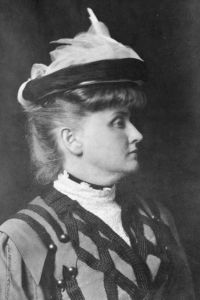
Gertrude Atherton

Gertrude Atherton

Summary

Portrait of Gertrude Atherton Gertrude Atherton,  The Striding Place (1896)

“ It was very dark in the depths where Weigall trod. He smiled as he recalled a remark of Gifford's: "An English wood is like a good many other things in life-- very promising at a distance, but a hollow mockery when you get within. You see daylight on both sides, and the sun freckles the very bracken. Our woods need the night to make them seem what they ought to be--what they once were, before our ancestors' descendants demanded so much more money, in these so much more various days." ”
Source: Wikisource

Portrait of Gertrude Atherton Gertrude Atherton,  The Striding Place (1896)

“ Weigall reached the pool. A man in his evening clothes floated on it, his face turned towards a projecting rock over which his arm had fallen, upholding the body. The hand that had held the branch hung limply over the rock, its white reflection visible in the black water. Weigall plunged into the shallow pool, lifted Gifford in his arms and returned to the bank. He laid the body down and threw off his coat that he might be the freer to practise the methods of resuscitation. He was glad of the moment's respite. The valiant life in the man might have been exhausted in that last struggle. ”
Source: Wikisource

Portrait of Gertrude Atherton Gertrude Atherton,  The Striding Place (1896)

“ In death the face was placid, intelligent, without ignoble lineation--the face of the man they had known at college. Weigall and Gifford had no time to comment there, and the afternoon and evening were full; but, coming forth from the house of festivity together, they had reverted almost at once to the topic.
"I cherish the theory," Gifford had said, "that the soul sometimes lingers in the body after death. During madness, of course, it is an impotent prisoner, albeit a conscious one.
”
Source: Wikisource

Get perspective with Kwize: daily news enlightened by great literature