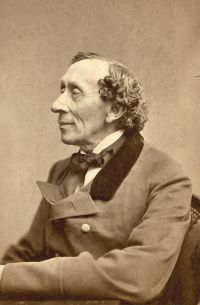
Hans Christian Andersen

Hans Christian Andersen

Summary

Portrait of Hans Christian Andersen Hans Christian Andersen Fairy Tales and Other Stories… (1914)

IB AND CHRISTINE
Not far from the stream Gudenaa, in the forest of Silkeborg, a great ridge of land rises and stretches along like a wall. By this ridge, westward, stands a farm-house, surrounded by poor land; the sandy soil is seen through the spare rye and wheat that grow upon it. Some years have elapsed since the time of which we speak. The people who lived here cultivated the fields, and moreover kept three sheep, a pig, and two oxen; in fact, they supported themselves quite comfortably, for they had enough to live on if they took things as they came.
Source: Wikisource

Portrait of Hans Christian Andersen Hans Christian Andersen Fairy Tales and Other Stories… (1914)

Not a human being was to be seen. At last a very little girl came out of a wretched house, Ib inquired of the little one the way to the street which he wanted; but she looked shyly at him, and began to cry bitterly. He asked her what ailed her, but could not understand what she said in reply. But as they were both under a lamp, and the light fell on the girl's face, he felt quite strange, for Christine stood bodily before him, just as he remembered her from the days of his childhood.
Source: Wikisource

Portrait of Hans Christian Andersen Hans Christian Andersen Fairy Tales and Other Stories… (1914)

Yes, it seemed right—in one of hers lay a golden carriage with horses, and in the other very elegant clothes; all those luxuries would now be Christine's in the capital. Her part had thus come true. And to him, Ib, the nut had offered only black earth. The gipsy woman had said this was 'the best of all for him'. Yes, it was right—that also was coming true. The black earth was the best for him. Now he understood clearly what had been the woman's meaning. In the black earth, in the dark grave, would be the best happiness for him.
Source: Wikisource

Get perspective with Kwize: daily news enlightened by great literature