Summary

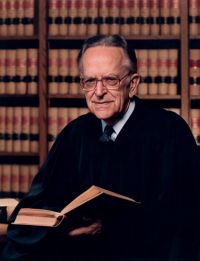
Portrait of Harry Blackmun Harry Blackmun Sullivan v. Stroop — Dissenting Opinion

Today the Court holds that the plain language of a statute applicable by its terms to "any child support payments" compels the conclusion that the statute does not apply to benefits paid to the dependent child of a disabled, retired, or deceased parent for the express purpose of supporting that child. Because I am persuaded that this crabbed interpretation of the statute is neither compelled by its language nor consistent with its purpose, and arbitrarily deprives certain families of a modest but urgently needed welfare benefit, I dissent.
Source: Wikisource

Portrait of Harry Blackmun Harry Blackmun Sullivan v. Stroop — Dissenting Opinion

Thus, the worker is legally compelled to set aside a portion of his wages in order to earn benefits used to support his dependent children in the event he becomes unable to do so himself. A child is entitled to Title II payments only if he or she lived with, or received financial support from, the insured worker-that is, only if the relationship between the child and the insured worker would (or did) give rise to a legally enforceable support obligation.
Source: Wikisource

Portrait of Harry Blackmun Harry Blackmun Sullivan v. Stroop — Dissenting Opinion

Even if the disregard rule were intended to serve as an incentive, that does not justify applying the disregard to all court-ordered support payments, but not to Title II benefits. Not all court-ordered support payments depend on the voluntary compliance of the absent parent; some are deducted directly from the absent parent's wages-just like Title II deductions. See n. 3, supra. Also, insofar as the disregard serves as an incentive for the custodial parent to help collect support payments, that purpose applies to Title II benefits as well as to court-ordered support payments.
Source: Wikisource

Get perspective with Kwize: daily news enlightened by great literature