Summary

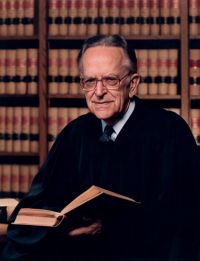
Portrait of Harry Blackmun Harry Blackmun Thornburgh v. Abbott — Opinion of the Court

It is clear from this language, however, that we did not deprive prison officials of the degree of discretion necessary to vindicate "the particular governmental interest involved." Accordingly, we said:
"Some latitude in anticipating the probable consequences of allowing certain speech in a prison environment is essential to the proper discharge of an administrator's duty. But any regulation or practice that restricts inmate correspondence must be generally necessary to protect one or more . . . legitimate governmental interests."
Source: Wikisource

Portrait of Harry Blackmun Harry Blackmun Thornburgh v. Abbott — Opinion of the Court

As we here do not apply the Martinez standard, we reject the Court of Appeals' sole ground for questioning the District Court's findings in this respect. In our view, when prison officials are able to demonstrate that they have rejected a less restrictive alternative because of reasonably founded fears that it will lead to greater harm, they succeed in demonstrating that the alternative they in fact selected was not an "exaggerated response" under Turner.
Source: Wikisource

Portrait of Harry Blackmun Harry Blackmun Thornburgh v. Abbott — Opinion of the Court

We agree that it is rational for the Bureau to exclude materials that, although not necessarily "likely" to lead to violence, are determined by the warden to create an intolerable risk of disorder under the conditions of a particular prison at a particular time. [15]
A second factor the Court in Turner held to be "relevant in determining the reasonableness of a prison restriction . . . is whether there are alternative means of exercising the right that remain open to prison inmates." 482 U.S., at 90, 107 S.Ct., at 2262.
Source: Wikisource

Get perspective with Kwize: daily news enlightened by great literature