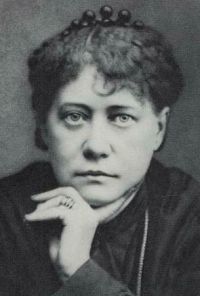
Helena Petrovna Blavatsky

Helena Petrovna Blavatsky

Summary

Portrait of Helena Petrovna Blavatsky Helena Petrovna Blavatsky The Voice Of The Silence/Preface (1889)

Another method (lug, in Tibetan) is to use the numerals and colors, each of which corresponds to a letter of the Tibetan alphabet (thirty simple and seventy-four compound letters) thus forming a complete cryptographic alphabet. When the ideographs are used there is a definite mode of reading the text; as in this case the symbols and signs used in astrology, namely the twelve zodiacal animals and the seven primary colors, each a triplet in shade, i.e. the light, the primary, and the dark—stand for the thirty-three letters of the simple alphabet, for words and sentences.
Source: Wikisource

Portrait of Helena Petrovna Blavatsky Helena Petrovna Blavatsky The Voice Of The Silence/Preface (1889)

Yet its maxims and ideas, however noble and original, are often found under different forms in Sanskrit works, such as the Dnyaneshvari, that superb mystic treatise in which Krishna describes to Arjuna in glowing colors the condition of a fully illumined Yogi; and again in certain Upanishads. This is but natural, since most, if not all, of the greatest Arhats, the first followers of Gautama Buddha were Hindus and Aryans, not Mongolians, especially those who emigrated into Tibet. The works left by Aryasanga alone are very numerous.
Source: Wikisource

Get perspective with Kwize: daily news enlightened by great literature