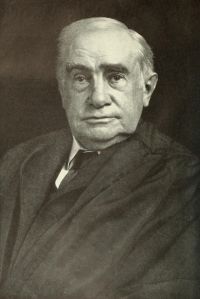
Henry Billings Brown

Henry Billings Brown

Summary

Portrait of Henry Billings Brown Henry Billings Brown McDonald v. Dewey — Dissent

Is it a responsibility only to pay debts of the bank as they existed at the time a fraudulent transfer was made? Not so; for the only liability imposed by the statute on the stockholders is an obligation to respond to an equal and ratable assessment made by the Comptroller to pay the debts existing at the time of the failure, Rev. Stat. §§ 5151, 5234, U.S.C.omp. Stat. 1901, pp. 3465, 3507. From this it results that, if a person is not a stockholder at the time of the failure, he is liable for nothing; and if he is such stockholder, he is liable for the statutory sum, and no other.
Source: Wikisource

Portrait of Henry Billings Brown Henry Billings Brown McDonald v. Dewey — Dissent

But there is nothing in the statute excluding, as another limit, that the transfer must not be to a person known to be irresponsible, and collusively made with the intent of escaping liability, and defeating the rights given by statute to creditors. Mrs. Valentine might be liable as a shareholder succeeding to the liabilities of Johnson, because she has voluntarily assumed that position; but that is no reason why Johnson should not, at the election of creditors, still be treated as a shareholder, he having, to escape liability, perpetrated a fraud on the statute.
Source: Wikisource

Portrait of Henry Billings Brown Henry Billings Brown McDonald v. Dewey — Dissent

Hitchcock, interpreting the Ohio law, the supreme court of Ohio held that, by the effect of the Constitution and laws of that state, a stockholder in an Ohio corporation who was subjected to a double liability was impotent to dispose of his stock, however bona fide might be the sale or disposition thereof, so as to escape liability to creditors who were such at the time of the transfer.
Source: Wikisource

Get perspective with Kwize: daily news enlightened by great literature