Summary

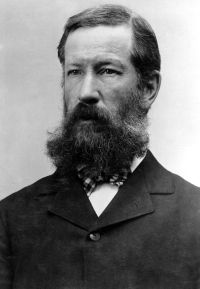
Portrait of Henry Gannett Henry Gannett Encyclopædia Britannica, Ninth Edition (1881)

Nevertheless language forms on the whole perhaps the most convenient basis of classification, and without its aid it would have been impossible to determine the affinities of many wide-spread races, such, for instance, as that of the Arizona Apaches with the Canadian Chippewyans, or on the other hand to separate nations apparently closely related, like the Iroquois from their Algonquin neighbours, or the Araucanians from the Peruvians. The true relations of many tribes are, on the other hand, still doubtful, because of uncertainty regarding the languages they speak.
Source: Wikisource

Portrait of Henry Gannett Henry Gannett Encyclopædia Britannica, Ninth Edition (1881)

While the area is larger than that of the United States, the Indian population is but about two-fifths as great, and the whites are but one-tenth. The Indians still hold their favourite hunting and fishing grounds; the game and fish have not yet sensibly decreased; and the whites do not yet so press upon them as to arouse their jealousy and suspicion. The history of the Indian tribes in the United States, from the time of the first occupation of the country by the whites, has been one of forced migrations, always westward, to make way for the repeated encroachments of civilization.
Source: Wikisource

Portrait of Henry Gannett Henry Gannett Encyclopædia Britannica, Ninth Edition (1881)

If man was evolved originally from several centres, America assuredly included one at least; if he sprang from a single pair, then we can even conceive that pair to have been first established in the New World, and the arguments brought forward in support of an Asiatic origin of the American would not lose their point if adduced in favour of an American origin of the Asiatic peoples.
Source: Wikisource

Get perspective with Kwize: daily news enlightened by great literature