Summary

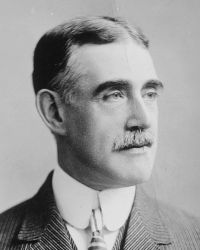
Portrait of Henry Jones Ford Henry Jones Ford Washington and his colleagues; a chronicle of the rise and fall of federalism (1918)

Jefferson was as urgent as was Hamilton. While Washington was still wavering, he received a strong letter from Edmund Randolph that doubtless touched his soldierly pride. The letter closed with this sharp argument:
"You suffered yourself to yield when the voice of your country summoned you to the Administration. Should a civil war arise, you cannot stay at home. And how much easier will it be to disperse the factions, which are rushing to this catastrophe, than to subdue them after they shall appear in arms? It is the fixed opinion of the world, that you surrender nothing incomplete."
Source: Gutenberg

Portrait of Henry Jones Ford Henry Jones Ford Washington and his colleagues; a chronicle of the rise and fall of federalism (1918)

Washington besought Congress to support the efforts of the Administration by making, for the defense of American interests, such provision as would inspire respect. In his address of December 3, 1793, he observed: "There is a rank due to the United States among nations which will be withheld, if not absolutely lost, by the reputation of weakness. If we desire to avoid insult, we must be able to repel it; if we desire to secure peace, one of the most powerful instruments of our rising prosperity, it must be known that we are at all times ready for war."
Source: Gutenberg

Portrait of Henry Jones Ford Henry Jones Ford Washington and his colleagues; a chronicle of the rise and fall of federalism (1918)

Government, it is true, like every other form of life, must meet the fundamental needs of subsistence and defense, but this truism supplies no explanation of the particular mode of doing so that may be adopted. Those needs account for motion but not for direction. Human will, discernment, and purpose enter and complicate the situation in a way that makes theories of determinism appear absurd. No one has ever contended that Hamilton was prompted by an economic motive in giving up his law practice to accept public office.
Source: Gutenberg

Get perspective with Kwize: daily news enlightened by great literature