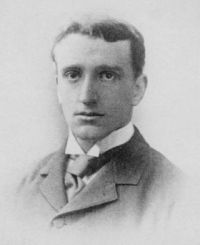
Herbert Treadwell Wade

Herbert Treadwell Wade

Summary

Portrait of Herbert Treadwell Wade Herbert Treadwell Wade The New International Encyclopædia (1905)

Gas or water pipes form excellent ‘earths,’ care being taken that the connection is made with the main pipe itself, and not with a branch, where a badly made point might spoil the connection. Where similar ‘earths’ are in use, as, for instance, a copper plate at one end and an iron pipe at the other, a quasi battery is created, and minute currents pass along the line; these, however, are too weak to be of consequence. The earth, being of great size, offers no sensible resistance to the passage of the current, in the same way that a large wire offers less resistance than a thin one.
Source: Wikisource

Portrait of Herbert Treadwell Wade Herbert Treadwell Wade The New International Encyclopædia (1905)

This is the technical term used in relation to the fact, discovered by Steinheil in 1838, that the earth itself serves the purpose of completing the circuit, and renders the employment of a second or return wire unnecessary. The ‘earth’ may consist of a buried plate of metal connected with the battery or line wire, and of sufficient surface to afford the necessary contact, with sufficient earth to make a good connection, it being understood that a small quantity of earth does not connect well.
Source: Wikisource

Get perspective with Kwize: daily news enlightened by great literature