Summary

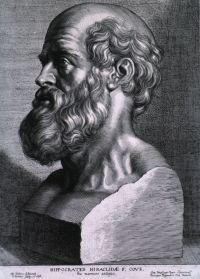
Portrait of Hippocrates Hippocrates On injuries to the head

And hence it happens that from similar or even smaller wounds and instruments, when a person is wounded to the same or a less degree, the bone of the head there is more contused, fractured, and depressed; and that injuries there are more deadly and more difficult to cure; and it is more difficult to save one's life in injuries there than in any other part of the head; that from having sustained a similar or even a less wound a man will die, and that, too, in a shorter space of time than from a wound in any other part of the head.
Source: Wikisource

Portrait of Hippocrates Hippocrates On injuries to the head

Of those who are wounded in the parts about the bone, or in the bone itself, by a fall, he who falls from a very high place upon a very hard and blunt object is in most danger of sustaining a fracture and contusion of the bone, and of having it depressed from its natural position; whereas he that falls upon more level ground, and upon a softer object, is likely to suffer less injury in the bone, or it may not be injured at all.
Source: Wikisource

Portrait of Hippocrates Hippocrates On injuries to the head

You must perform incision on wounds situated on the head and forehead, whenever the bone is denuded of flesh, and appears to have sustained some injury from the blow, but the wound has not sufficient length and breadth for the inspection of the bone, so that it may be seen whether it has received any mischief from the blow, and of what nature the injury is, and to what extent the flesh has been contused, and whether the bone has sustained any injury, or whether it be uninjured by the blow, and has suffered no mischief
Source: Wikisource

Get perspective with Kwize: daily news enlightened by great literature