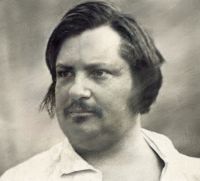
Honoré de Balzac

Honoré de Balzac

Summary

Portrait of Honoré de Balzac Honoré de Balzac Ursule Mirouët — Part I, Section 2 (1842)

There are beings, good and patient like him, who pass through life with a bitter thought in the heart and a smile both tender and mournful on the lips, bearing with them the solution to the riddle without allowing it to be fathomed, through pride, disdain or vengeance perhaps, having none but God for confidant and comforter. Monsieur de Jordy saw no one at Nemours—where, like the doctor, he had come to die in peace—but the curé, always at the disposal of his parishioners, and Madame de Portenduère, who used to go to bed at nine o’clock.
Source: Wikisource

Portrait of Honoré de Balzac Honoré de Balzac Ursule Mirouët — Part I, Section 2 (1842)

Crémière, Massin and Minoret-Levrault, exceedingly vulgar people, were mercilessly summed up by the doctor from the first two months during which they tried to encompass, not so much the uncle, as the inheritance. People who are guided by instinct have this disadvantage compared to people of ideas, that they are at once found out; instinct’s inspirations are too natural, and appeal too much to the eye not to be immediately perceived; whilst, to be fathomed, the conceptions of intellect demand an equal intelligence on both sides.
Source: Wikisource

Portrait of Honoré de Balzac Honoré de Balzac Ursule Mirouët — Part I, Section 2 (1842)

Whilst traveling through France, where the eye so quickly wearies of the monotony of the plains, who is there that has not felt the delicious sensation from the top of a hill, from its slope or at the turn, just when the promise is of a barren landscape, of discovering a fresh valley watered by a river, and a little town sheltered under the rock like a hive in the hollow of an old willow?
Source: Wikisource

Get perspective with Kwize: daily news enlightened by great literature