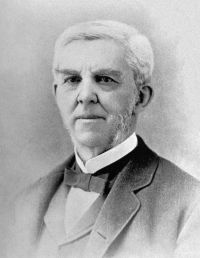
Oliver Wendell Holmes Sr.

Oliver Wendell Holmes Sr.

Summary

Portrait of Oliver Wendell Holmes Sr. Oliver Wendell Holmes Sr. Elsie Venner — Chapter XXII (1891)

He turned it aside with the remark, that Shakespeare seemed to him at times to come as near inspiration as any human being not included among the sacred writers.
"Doctor," the physician began, as from a sudden suggestion, "you won't quarrel with me, if I tell you some of my real thoughts, will you?"
"Say on, my dear Sir, say on," the minister answered, with his most genial smile; "your real thoughts are just what I want to get at. A man's real thoughts are a great rarity.
Source: Wikisource

Portrait of Oliver Wendell Holmes Sr. Oliver Wendell Holmes Sr. Elsie Venner — Chapter XXII (1891)

Ministers talk about the human will as if it stood on a high look-out, with plenty of light, and elbowroom reaching to the horizon. Doctors are constantly noticing how it is tied up and darkened by inferior organization, by disease, and all sorts of crowding interferences, until they get to look upon Hottentots and Indians--and a good many of their own race as a kind of self-conscious blood-clocks with very limited power of self-determination.
Source: Wikisource

Portrait of Oliver Wendell Holmes Sr. Oliver Wendell Holmes Sr. Elsie Venner — Chapter XXII (1891)

So in the face of the fact that civilization with all it offers has proved a dead failure with the aboriginal races of this country,--on the whole, I say, a dead failure,--they talk as if they knew from their own will all about that of a Digger Indian! We are more apt to go by observation of the facts in the case. We are constantly seeing weakness where you see depravity. I don't say we're right; I only tell what you must often find to be the fact, right or wrong, in talking with doctors. You see, too, our notions of bodily and moral disease, or sin, are apt to go together.
Source: Wikisource

Get perspective with Kwize: daily news enlightened by great literature