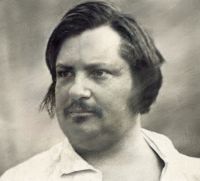
Honoré de Balzac

Honoré de Balzac

Summary

Portrait of Honoré de Balzac Honoré de Balzac Ursule Mirouët — Part I, Section 4 (1842)

When she tried to speak, or when she fixed her beautiful soft blue eyes on all objects, with that reflective look which seems to be the dawning of thought and which she ended in a laugh, he would remain beside her for hours together, seeking, with Jordy, the reasons, which so many other people call caprices, hidden under the slightest phenomena of this delicious phase of life when the child is at once blossom and fruit, a confused intelligence, a perpetual movement, and a passionate longing.
Source: Wikisource

Portrait of Honoré de Balzac Honoré de Balzac Ursule Mirouët — Part I, Section 4 (1842)

Ursule’s beauty and gentleness endeared her so much to the doctor, that he would have liked to change all the laws of Nature for her; he sometimes told old Jordy that his teeth ached when Ursule was cutting hers. When old men love children, they place no bounds upon their passion, but adore them. For the sake of these little beings, they suppress their hobbies, and for them call to mind their own past.
Source: Wikisource

Portrait of Honoré de Balzac Honoré de Balzac Ursule Mirouët — Part I, Section 4 (1842)

In short, with them as with children, life is reduced to simplicity; and if sentiment makes a slave of the mother, the detachment of all passion and the absence of all self-interest permits an old man to give himself up entirely. It is also no uncommon thing to see children on good terms with old people. The old soldier, the old curé and the old doctor, happy in Ursule’s caresses and coquetries, never tired of answering her or playing with her.
Source: Wikisource

Get perspective with Kwize: daily news enlightened by great literature