Summary

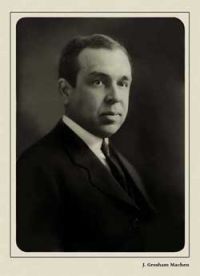
Portrait of J. Gresham Machen J. Gresham Machen The Origin of Paul's Religion

But how would it be if the underlying problem could be faced, instead of being ignored? How would it be if human nature could be founded upon some secure rock, in order that then the architect might start to build once more, and build, this time, with a conscience void of offense? Such is the Christian ideal, the ideal of a loftier humanism—a humanism as rich and as joyful as the humanism of Greece, but a humanism founded upon the grace of God.
Source: Gutenberg

Portrait of J. Gresham Machen J. Gresham Machen The Origin of Paul's Religion

If second-century paganism, without at all modifying its essential character, could sometimes actually adopt the name of Christ, why should it be thought incredible that the compiler of the Hermetic literature, who did not go quite so far, should yet have permitted Christian elements to creep into his syncretistic work? Why should similarity of language between Hermes and Paul, supposing that it exists, be regarded as proving dependence of Paul upon a type of paganism like that of Hermes, rather than dependence of Hermes upon Paul?
Source: Gutenberg

Portrait of J. Gresham Machen J. Gresham Machen The Origin of Paul's Religion

If the Law was so very strict as the Pharisees said it was, if its commands entered so deep into every department of life, if the penalty which it imposed upon disobedience was nothing less than loss of the favor of a righteous God, would not the man who was placed under such a régime come to recognize the imperfection of his obedience to the countless commands and so be oppressed by a sense of guilt? Paul said that the Law was a schoolmaster to bring the Jews to Christ, and by that he meant that the Law produced the consciousness of sin.
Source: Gutenberg

Get perspective with Kwize: daily news enlightened by great literature