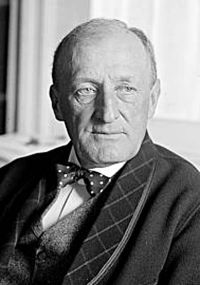
James Clark McReynolds

James Clark McReynolds

Summary

Portrait of James Clark McReynolds James Clark McReynolds Charles Mason v. United States…

A question which might appear at first sight a very innocent one might, by affording a link in a chain of evidence, become the means of bringing home an offense to the party answering. Subject to this reservation, a judge is, in our opinion, bound to insist on a witness answering unless he is satisfied that the answer will tend to place the witness in peril.
Source: Wikisource

Portrait of James Clark McReynolds James Clark McReynolds Charles Mason v. United States…

The principle which entitles the United States to the testimony of every citizen, and the principle by which every witness is privileged not to accuse himself, can neither of them be entirely disregarded. They are believed both to be preserved to a reasonable extent, and according to the true intention of the rule and of the exception to that rule, by observing that course which it is conceived courts have generally observed. It is this: When a question is propounded, it belongs to the court to consider and to decide whether any direct answer to it can implicate the witness.
Source: Wikisource

Portrait of James Clark McReynolds James Clark McReynolds Charles Mason v. United States…

We think that a merely remote and naked possibility, out of the ordinary course of law and such as no reasonable man would be affected by, should not be suffered to obstruct the administration of justice. The object of the law is to afford to a party, called upon to give evidence in a proceeding inter alios, protection against being brought by means of his own evidence within the penalties of the law.
Source: Wikisource

Get perspective with Kwize: daily news enlightened by great literature