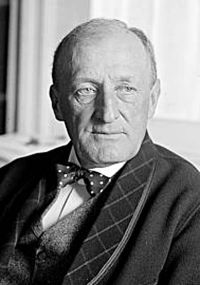
James Clark McReynolds

James Clark McReynolds

Summary

Portrait of James Clark McReynolds James Clark McReynolds Meyer v. Nebraska — Opinion of the Court (1923)

That the State may do much, go very far, indeed, in order to improve the quality of its citizens, physically, mentally and morally, is clear; but the individual has certain fundamental rights which must be respected. The protection of the Constitution extends to all, to those who speak other languages as well as to those born with English on the tongue.
Source: Wikisource

Portrait of James Clark McReynolds James Clark McReynolds Meyer v. Nebraska — Opinion of the Court (1923)

Without doubt, it denotes not merely freedom from bodily restraint, but also the right of the individual to contract, to engage in any of the common occupations of life, to acquire useful knowledge, to marry, establish a home and bring up children, to worship God according to the dictates of his own conscience, and generally to enjoy those privileges long recognized at common law as essential to the orderly pursuit of happiness by free men.
Source: Wikisource

Portrait of James Clark McReynolds James Clark McReynolds Meyer v. Nebraska — Opinion of the Court (1923)

No emergency has arisen which renders knowledge by a child of some language other than English so clearly harmful as to justify its inhibition with the consequent infringement of rights long freely enjoyed. We are constrained to conclude that the statute as applied is arbitrary and without reasonable relation to any end within the competency of the State.
Source: Wikisource

Get perspective with Kwize: daily news enlightened by great literature