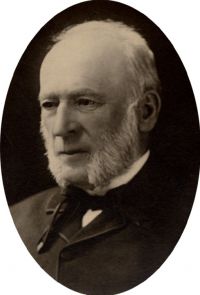
James MacPherson Le Moine

James MacPherson Le Moine

Summary

Portrait of James MacPherson Le Moine James MacPherson Le Moine Marie-Josephte Corriveau, A Canadian Lafarge (1863)

The agonizing man struggled hard, calling loudly for help, when the inhuman monster, having made fast the end of the rope outside the house, rushed in to feast her eyes on the inanimate form of the man whom, shortly before, she had sworn "to love, respect and obey", but instead of confronting a hideous corpse, with protruding eyes and stiffened limbs, her astonished gaze rested on the figure of a man quietly seated on a chair, close to her bed.
Source: Wikisource

Portrait of James MacPherson Le Moine James MacPherson Le Moine Marie-Josephte Corriveau, A Canadian Lafarge (1863)

I intend now to rescue from the oblivion of the past, a hideous figure, a being whose supposed fate stamped on the early times of British rule in Canada, a brand of ferocity which they scarcely deserve. An authentic document, discovered within a few years, throws a very desirable light on a question much debated at one time, — I allude to the mode of execution adopted by one of General Murray's court-martials in 1763, with respect to Marie Josephte Corriveau.
Source: Wikisource

Portrait of James MacPherson Le Moine James MacPherson Le Moine Marie-Josephte Corriveau, A Canadian Lafarge (1863)

Until the discovery of the proceedings of the court-martial which tried the Corriveaus, popular superstition, ever prone to distort and magnify distant and mysterious events, had awarded to Marie Josephte Corriveau's crimes a punishment of which a parallel exists in that inflicted by Louis XI on a cardinal and bishop named Balue, who having been detected in a treasonable intrigue, was confined for many years in an iron cage, which, till lately, was shown in the castle of Loches, France.
Source: Wikisource

Get perspective with Kwize: daily news enlightened by great literature