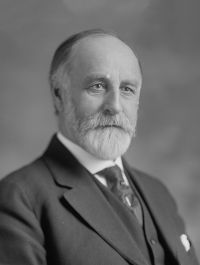
Jesse Walter Fewkes

Jesse Walter Fewkes

Summary

Portrait of Jesse Walter Fewkes Jesse Walter Fewkes The Alósaka cult of the Hopi Indians (1899)

It would seem from all these stories that the Alósaka cult was vigorous in Awatobi, the ill-fated pueblo where the zealous Padre Porras lost his life in 1633, and that it was of southern origin, having been introduced into Awatobi by one of the phratries from the south which lived in the now ruined pueblos on the Little Colorado. The most complicated survival of the Alósaka cultus is to be expected in the Middle Mesa pueblos, because the phratry which introduced it founded some of these pueblos [30] and still survives there.
Source: Gutenberg

Portrait of Jesse Walter Fewkes Jesse Walter Fewkes The Alósaka cult of the Hopi Indians (1899)

The Alósaka cult may be regarded as another form of that totemic ancestor worship which appears in all Hopi mythology and ritual. The male and female Alósakas are supposed to be ancestors of a cult society called the Aaltû, and are represented symbolically in the ritual by graven images, pictures, or personations by men. The name Alósaka is simply a sacerdotal name used in this society, but it is applied to a similar conception found in the worship of other societies under other names.
Source: Gutenberg

Portrait of Jesse Walter Fewkes Jesse Walter Fewkes The Alósaka cult of the Hopi Indians (1899)

There is a priesthood at Walpi called the Aaltû or Horn-men (to whom the name Alósaka is also given) , who are the special guardians of the cult and who perform rites which throw light on its nature. These Aaltû, in their personifications of Alósakas, wear on their heads close-fitting wicker caps, [3] on which are mounted two large, artificial, curved projections made of buckskin, painted white, and resembling horns of the mountain sheep [4] which, in certain of their actions, the Aaltû imitate.
Source: Gutenberg

Get perspective with Kwize: daily news enlightened by great literature