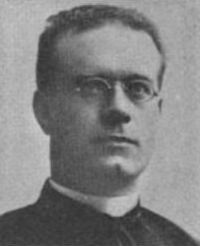
Johann Peter Kirsch

Johann Peter Kirsch

Summary

Portrait of Johann Peter Kirsch Johann Peter Kirsch Catholic Encyclopedia (1913)

The night of his marriage he secretly left his father's house and journeyed to Edessa in the Syrian Orient where, for seventeen years, he led the life of a pious ascetic. As the fame of his sanctity grew, he left Edessa and returned to Rome, where, for seventeen years, he dwelt as a beggar under the stairs of his father's palace, unknown to his father or wife.
Source: Wikisource

Portrait of Johann Peter Kirsch Johann Peter Kirsch Catholic Encyclopedia (1913)

To Agricola belongs the palm as pioneer of classical learning in Germany. His importance cannot be estimated by the works which he wrote; he must be classed with those who accomplished more by their personal influence, and the powerful stimulus they gave to their contemporaries than by their own literary achievements. Thus we gather the full significance of Agricola's work from the testimony of his contemporaries, who bestow upon him the highest praise.
Source: Wikisource

Portrait of Johann Peter Kirsch Johann Peter Kirsch Catholic Encyclopedia (1913)

If there is a kernel of historical truth in the narrative, it has not as yet been possible to sift it out from the later embellishments. In their present form the Latin Acts are not older than the sixth century. According to them Agatha, daughter of a distinguished family and remarkable for her beauty of person, was persecuted by the Senator Quintianus with avowals of love. As his proposals were resolutely spurned by the pious Christian virgin, he committed her to the charge of an evil woman, whose seductive arts, however, were baffled by Agatha's unswerving firmness in the Christian faith.
Source: Wikisource

Get perspective with Kwize: daily news enlightened by great literature