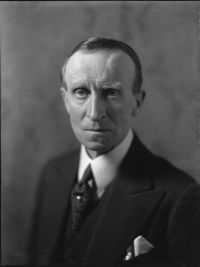
John Buchan

John Buchan

Summary

Portrait of John Buchan John Buchan Greenmantle — Chapter 11 (1916)

There was no sound or sight behind us in the dark lane which dipped to the harbour.
'This is a queer country, Cornelis,' said Peter, feeling his limbs for bruises. 'Too many things happen in too short a time. I am breathless.'
The big street we had struck seemed to run along the crest of the hill. There were lamps in it, and crawling cabs, and quite civilized-looking shops. We soon found the hotel to which Kuprasso had directed us, a big place in a courtyard with a very tumble-down- looking portico, and green sun-shutters which rattled drearily in the winter's wind.
Source: Wikisource

Portrait of John Buchan John Buchan Greenmantle — Chapter 11 (1916)

It became the Garden-House of Suliman the Red, whoever that sportsman may have been. Sandy had said that the ends of the earth converged there, and he had been right. I lost all consciousness of my neighbours—stout German, frock-coated Turk, frowsy Jewess—and saw only strange figures leaping in a circle of light, figures that came out of the deepest darkness to make a big magic.
The leader flung some stuff into the brazier, and a great fan of blue light flared up. He was weaving circles, and he was singing something shrill and high, whilst his companions made a chorus with their deep monotone.
Source: Wikisource

Portrait of John Buchan John Buchan Greenmantle — Chapter 11 (1916)

Rasta and Stumm seemed feeble simpletons by contrast. The window I had been looking out of was changed to a prison wall—I could see the mortar between the massive blocks. In a second these devils would be smelling out their enemies like some foul witch-doctors. I felt the burning eyes of their leader looking for me in the gloom. Peter was praying audibly beside me, and I could have choked him. His infernal chatter would reveal us, for it seemed to me that there was no one in the place except us and the magic-workers.
Source: Wikisource

Get perspective with Kwize: daily news enlightened by great literature