Summary

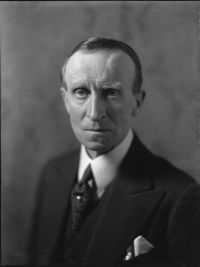
Portrait of John Buchan John Buchan,  Midwinter (Buchan) — Chapter I. (1923)

“ I am gentle born, as you guess, and have been in my day scholar and soldier, but now my companions are the moor-men and the purley-men and the hill-shepherds and the raggle-taggle gypsies. And I am wholly content, for my calling is philosophy. I stand aside in life, and strike no blows and make no bargain, but I learn that which is hid from others."
Alastair stirred impatiently.
"You are not above forty," he said. "You have health and wits and spirit. Great God, man, have you no cause or leader to fight for? Have you no honest ambition to fulfil before you vanish into the dark?"
”
Source: Wikisource

Portrait of John Buchan John Buchan,  Midwinter (Buchan) — Chapter I. (1923)

“ Midwinter finished his pipe, sitting hunched among the furs, with his eyes fixed steadily on the young man. There was a mesmerism in those eyes which postponed sleep, and drove Alastair to speak. Besides, the lilt sung by the fire still hummed in his ears.
"Who told you my name?" he asked.
"That were too long a tale. Suffice it to say that I knew of your coming, and that long before Banbury you entered the orbit of my knowledge. Nay, sir, I can tell you also your errand, and I warn you that you will fail. You are about to beat at a barred and bolted door."
”
Source: Wikisource

Portrait of John Buchan John Buchan,  Midwinter (Buchan) — Chapter I. (1923)

“ There is an Old England which has outlived Roman and Saxon and Dane and Norman and will outlast the Hanoverian. It has seen priest turn to presbyter and presbyter to parson and has only smiled. It is the land of the edge of moorlands and the rims of forests and the twilight before dawn, and strange knowledge still dwells in it. Lords and Parliament-men bustle about, but the dust of their coaches stops at the roadside hedges, and they do not see the quiet eyes watching them at the fords. Those eyes are their masters, young sir. ”
Source: Wikisource

Get perspective with Kwize: daily news enlightened by great literature