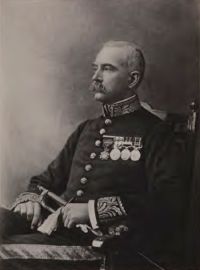
John Claude White

John Claude White

Summary

Portrait of John Claude White John Claude White Sikhim and Bhutan — Chapter XIV … (1909)

Possibly the excellence of the work produced in Bhutan owes much to the feudal system which still prevails there. Each Penlop and Jongpen has his own workmen amongst his retainers, men who are not paid by the piece, and are not obliged either to work up to time or to work if the spirit is not in them, and consequently they put their souls into what they do, with the result that some pieces of splendid individuality and excellent finish are still made. No two pieces are ever quite alike, and each workman leaves his impress on his work.
Source: Wikisource

Portrait of John Claude White John Claude White Sikhim and Bhutan — Chapter XIV … (1909)

Amid a salute of guns, which reverberated grandly through the rocky gorge, we emerged from the bridge, where a procession of gaily dressed minstrel singers and dancers met us, and conducted us up the hilly zigzag singing verses of praise and welcome in a curious but not unpleasant monotone. There were seven women singers, peculiar to Bhutan, four clarion players, two drummers, and two gong-strikers in addition to the dancers.
Source: Wikisource

Portrait of John Claude White John Claude White Sikhim and Bhutan — Chapter XIV … (1909)

Paul, and the Subadar, and in front of each chair was a small table with fruit and refreshments. Close behind us stood my orderlies with presents. On the opposite side of the nave, facing me, was a low daïs with a magnificent cushion of the richest salmon-coloured brocade, on which Sir Ugyen Wang-chuk sat, dressed in a handsome robe of dark blue Chinese silk, embroidered in gold with the Chinese character “Fu,” the sign emblematical of good luck. Below him were ranged the chairs of all the officials present, the Thimbu Jongpen, the Poonakha Jongpen, the Zung Donyer, and the Deb Zimpon.
Source: Wikisource

Get perspective with Kwize: daily news enlightened by great literature