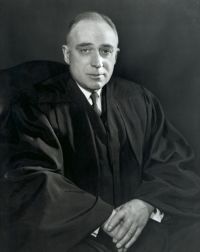
John Marshall Harlan II

John Marshall Harlan II

Summary

Portrait of John Marshall Harlan II John Marshall Harlan II Berger v. New York/Dissent II…

The Court today entirely disregards this principle. In its haste to give force to its distaste for eavesdropping, it has apparently resolved that no attention need be given to the construction of § 813-a adopted by the state courts. Apart from a brief and partial acknowledgment, spurred by petitioner's concession, that the state cases might warrant exploration, the Court has been content simply to compare the terms of the statute with the provisions of the Fourth Amendment; upon discovery that their words differ, it has concluded that the statute is constitutionally impermissible.
Source: Wikisource

Portrait of John Marshall Harlan II John Marshall Harlan II Berger v. New York/Dissent II…

The Court in recent years has more and more taken to itself sole responsibility for setting the pattern of criminal law enforcement throughout the country. Time-honored distinctions between the constitutional protections afforded against federal authority by the Bill of Rights and those provided against the action by the Fourteenth Amendment have been obliterated, thus increasingly subjecting state criminal law enforcement policies to oversight by this Court.
Source: Wikisource

Portrait of John Marshall Harlan II John Marshall Harlan II Berger v. New York/Dissent II…

There is no need for present purposes to explore at length the question's subtleties; it suffices to indicate that, in my view, conversations are not "seized" either by eavesdropping alone, or by their recording so that they may later be heard at the eavesdropper's convenience. Just as some exercise of dominion, beyond mere perception, is necessary for the seizure of tangibles so some use of the conversation beyond the initial listening process is required for the seizure of the spoken word.
Source: Wikisource

Get perspective with Kwize: daily news enlightened by great literature