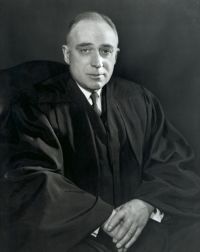
John Marshall Harlan II

John Marshall Harlan II

Summary

Portrait of John Marshall Harlan II John Marshall Harlan II Malloy v. Hogan — Dissent

If the power of the States to deal with local crime is unduly restricted, the likely consequence is a shift of responsibility in this area to the Federal Government, with its vastly greater resources. Such a shift, if it occurs, may in the end serve to weaken the very liberties which the Fourteenth Amendment safeguards by bringing us closer to the monolithic society which our federalism rejects. Equally dangerous to our liberties is the alternative of watering down protections against the Federal Government embodied in the Bill of Rights so as not unduly to restrict the powers of the States.
Source: Wikisource

Portrait of John Marshall Harlan II John Marshall Harlan II Malloy v. Hogan — Dissent

The Court's approach in the present case is in fact nothing more or less than 'incorporation' in snatches. If, however, the Due Process Clause is something more than a reference to the Bill of Rights and protects only those rights which derive from fundamental principles, as the majority purports to believe, it is just as contrary to precedent and just as illogical to incorporate the provisions of the Bill of Rights one at a time as it is to incorporate them all at once.
Source: Wikisource

Portrait of John Marshall Harlan II John Marshall Harlan II Malloy v. Hogan — Dissent

Rather than insisting, almost by rote, that the Connecticut court, in considering the petitioner's claim of privilege, was required to apply the 'federal standard,' the Court should have fulfilled its responsibility under the Due Process Clause by inquiring whether the proceedings below met the demands of fundamental fairness which due process embodies. Such an approach may not satisfy those who see in the Fourteenth Amendment a set of easily applied 'absolutes' which can afford a haven from unsettling doubt.
Source: Wikisource

Get perspective with Kwize: daily news enlightened by great literature