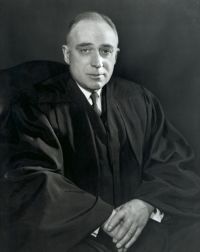
John Marshall Harlan II

John Marshall Harlan II

Summary

Portrait of John Marshall Harlan II John Marshall Harlan II United States v. Florida — Dissent

This is not to say that Congress could not at the same time have changed any State's original admission boundary, but only to raise the question whether it in fact did so. While the exercise of a particular constitutional power does not of course preclude resort to others, the nature of the power exerted in 1868 does seem to me to negative the idea that Congress also purported to exercise its power to change Florida's boundary.
Source: Wikisource

Portrait of John Marshall Harlan II John Marshall Harlan II United States v. Florida — Dissent

No territorial questions at all appear to have figured in the debates. In these circumstances the case of State of Virginia v. State of Tennessee, 148 U.S. 503, 13 S.Ct. 728, 37 L.Ed. 537, upon which Florida relies in support of its argument as to implied approval, is quite inapposite. There the two States had made a compact with respect to the boundary between them. Subsequently Congress adopted the line so established in setting up districts for judicial, revenue, election, and appointive purposes. It was held that Congress had thereby impliedly approved the interstate compact.
Source: Wikisource

Portrait of John Marshall Harlan II John Marshall Harlan II United States v. Florida — Dissent

Cf. United States v. State of California, supra, 67 U.S. at pages 39-40, 67 S.Ct. at pages 1668 1669. Moreover, to say that such a duty existed seems to me to misconceive the nature of the 'approval' of the constitutions of the seceded States contemplated by the reconstruction statutes. Such approval was not of the sort involved in the case of a constitution submitted to a constitutional convention for adoption or ratification, where the failure to reject a particular provision would be equivalent to its acceptance.
Source: Wikisource

Get perspective with Kwize: daily news enlightened by great literature