Summary

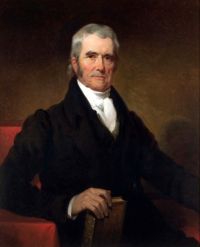
Portrait of John Marshall John Marshall Horsburg v. Baker — Opinion of the Court

As a Court of Chancery is not the proper tribunal for enforcing forfeitures, no decree for the purpose of effecting that object, ought to have been made. But the plaintiff had a right to apply to the Court of Chancery for a discovery, in order to enable him to proceed at law, either immediately, or on the death of Martin Baker and his wife; and also, for an injunction, to restrain the tenants for life from removing the slaves out of the country. The decree dismissing the bill, entirely defeats both these objects.
Source: Wikisource

Portrait of John Marshall John Marshall Horsburg v. Baker — Opinion of the Court

The bill further states, that the said Alexander Horsburg departed this life in the year 1798, having first made his last will in writing, whereby he bequeathed the residue of his estate to his wife, who afterwards intermarried with the plaintiff, James Henderson.
The bill proceeds to state, that Martin Baker and wife have removed to Kentucky with the slave Charlotte, and her increase; whom they profess to hold as their absolute property
Source: Wikisource

Portrait of John Marshall John Marshall Horsburg v. Baker — Opinion of the Court

The amended bill, therefore, prays a decree for the slaves themselves. After this bill was filed, the defendants, Baker and wife, answer; and make the discovery with respect to the descendants of Charlotte.
In this state of the cause, the plaintiff dies, and his administrator and devisee, files a bill in the nature of a bill of revivor.
After answer and discovery, the rule is, that a suit brought merely for discovery, cannot be revived. 1 Mad. 217. 1 Dick. 133. 10 Vez. 31. Its object is obtained, and the plaintiff has no motive for reviving it. But such a bill ought not to be dismissed, 1 Mad.
Source: Wikisource

Get perspective with Kwize: daily news enlightened by great literature