Summary

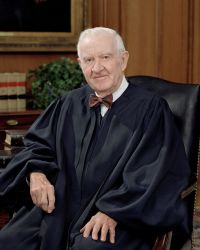
Portrait of John Paul Stevens John Paul Stevens Board of Education of Westside Community Schools v…

Can Congress really have intended to issue an order to every public high school in the Nation stating, in substance, that if you sponsor a chess club, a scuba diving club, or a French club without having formal classes in those subjects-you must also open your doors to every religious, political, or social organization, no matter how controversial or distasteful its views may be?
Source: Wikisource

Portrait of John Paul Stevens John Paul Stevens Board of Education of Westside Community Schools v…

We would do no honor to Westside's administrators or the Congress by assuming that either treated casually the differences between high school and college students when formulating the policy and the statute at issue here.
For these reasons, I believe that the distinctions between Westside's program and the University of Missouri's program suggest what is the best understanding of the Act: An extracurricular student organization is "noncurriculum related" if it has as its purpose (or as part of its purpose) the advocacy of partisan theological, political, or ethical views.
Source: Wikisource

Portrait of John Paul Stevens John Paul Stevens Board of Education of Westside Community Schools v…

Under the plurality's interpretation of the Act, Congress has imposed a difficult choice on public high schools receiving federal financial assistance. If such a school continues to allow students to participate in such familiar and innocuous activities as a school chess or scuba diving club, it must also allow religious groups to make use of school facilities. In deed, it is hard to see how a cheerleading squad or a pep club, among the most common student groups in American high schools, could avoid being "noncurriculum related" under the majority's test.
Source: Wikisource

Get perspective with Kwize: daily news enlightened by great literature