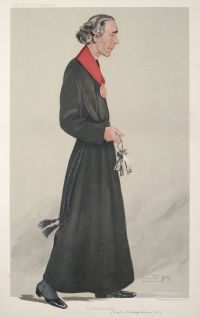
Joseph Armitage Robinson

Joseph Armitage Robinson

Summary

Portrait of Joseph Armitage Robinson Joseph Armitage Robinson Somerset Historical Essays (1921)

BISHOP JOCELIN AND THE INTERDICT
The passing of the twelfth century into the thirteenth is a moment of great interest in English history, alike in the Church and in the State. The strong hand of a great king had been withdrawn from the helm of the nation; his successor had spent his whole time and force on enterprises of enthusiasm outside England: and when Richard of the Lion's heart was gone, his brother John lost Normandy for ever and was shut up to misgovern England.
Source: Wikisource

Portrait of Joseph Armitage Robinson Joseph Armitage Robinson Somerset Historical Essays (1921)

So he died an archdeacon—not of Bath indeed, but of London; and his latest letters are pathetic protests to the pope that he has no revenue to support his title, and that the new precentor of St Paul's has ousted him from his stall which was the second in honour to that of the dean.
It is impossible to make a hero of Peter, but his story has much of human interest, and it runs in and out among the great events of a fascinating period of history. His letters indeed are indispensable to the historian; for again and again they take him behind the scenes.
Source: Wikisource

Portrait of Joseph Armitage Robinson Joseph Armitage Robinson Somerset Historical Essays (1921)

What would this mean but a college of cardinals, with the archbishop sitting as a kind of pope? A new patriarchate would be formed: all causes ecclesiastical would be heard in this court, and none would henceforth cross the sea: England would be to all intents and purposes severed from Rome. The monks, of course, would cease to be 'the church of Canterbury': the new cathedral would supersede the old by sheer force of wealth and influence: it might even claim the body of the martyr in whose name it was dedicated.
Source: Wikisource

Get perspective with Kwize: daily news enlightened by great literature