Summary

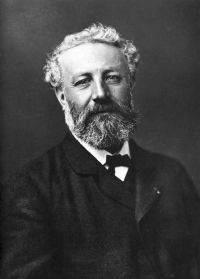
Portrait of Jules Verne Jules Verne 20,000 Leagues Under the Seas… (1870)

Conseil was my manservant. A devoted lad who went with me on all my journeys; a gallant Flemish boy whom I genuinely liked and who returned the compliment; a born stoic, punctilious on principle, habitually hardworking, rarely startled by life's surprises, very skillful with his hands, efficient in his every duty, and despite his having a name that means "counsel," never giving advice-- not even the unsolicited kind!
Source: Wikisource

Portrait of Jules Verne Jules Verne 20,000 Leagues Under the Seas… (1870)

Just then Commander Farragut was giving orders to cast off the last moorings holding the Abraham Lincoln to its Brooklyn pier. And so if I'd been delayed by a quarter of an hour or even less, the frigate would have gone without me, and I would have missed out on this unearthly, extraordinary, and inconceivable expedition, whose true story might well meet with some skepticism.
But Commander Farragut didn't want to waste a single day, or even a single hour, in making for those seas where the animal had just been sighted. He summoned his engineer.
"Are we up to pressure?" he asked the man.
Source: Wikisource

Portrait of Jules Verne Jules Verne 20,000 Leagues Under the Seas… (1870)

The Abraham Lincoln had been perfectly chosen and fitted out for its new assignment. It was a high-speed frigate furnished with superheating equipment that allowed the tension of its steam to build to seven atmospheres. Under this pressure the Abraham Lincoln reached an average speed of 18.3 miles per hour, a considerable speed but still not enough to cope with our gigantic cetacean.
Source: Wikisource

Get perspective with Kwize: daily news enlightened by great literature