Summary

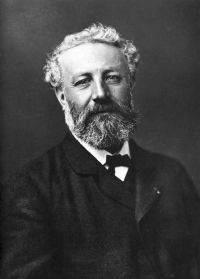
Portrait of Jules Verne Jules Verne 20,000 Leagues Under the Seas… (1870)

Near two o'clock in the morning, the core of light reappeared, no less intense, five miles to windward of the Abraham Lincoln. Despite the distance, despite the noise of wind and sea, we could distinctly hear the fearsome thrashings of the animal's tail, and even its panting breath. Seemingly, the moment this enormous narwhale came up to breathe at the surface of the ocean, air was sucked into its lungs like steam into the huge cylinders of a 2,000-horsepower engine.
"Hmm!" I said to myself. "A cetacean as powerful as a whole cavalry regiment--now that's a whale of a whale!"
Source: Wikisource

Portrait of Jules Verne Jules Verne 20,000 Leagues Under the Seas… (1870)

I answered with conviction. "Not even angel-wing clams or salps have ever given off such a powerful light. That glow is basically electric in nature. Besides . . . look, look! It's shifting! It's moving back and forth! It's darting at us!"
A universal shout went up from the frigate.
"Quiet!" Commander Farragut said. "Helm hard to leeward! Reverse engines!"
Sailors rushed to the helm, engineers to their machinery. Under reverse steam immediately, the Abraham Lincoln beat to port, sweeping in a semicircle.
"Right your helm! Engines forward!" Commander Farragut called.
Source: Wikisource

Portrait of Jules Verne Jules Verne 20,000 Leagues Under the Seas… (1870)

By then Commander Farragut, Ned Land, and I were on the afterdeck, peering eagerly into the profound gloom.
"Ned Land," the commander asked, "you've often heard whales bellowing?"
"Often, sir, but never a whale like this, whose sighting earned me $2,000.00."
"Correct, the prize is rightfully yours. But tell me, isn't that the noise cetaceans make when they spurt water from their blowholes?"
"The very noise, sir, but this one's way louder. So there can be no mistake. There's definitely a whale lurking in our waters.
Source: Wikisource

Get perspective with Kwize: daily news enlightened by great literature