Summary

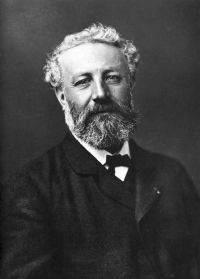
Portrait of Jules Verne Jules Verne 20,000 Leagues Under the Seas… (1870)

Captain Nemo, during the squalls, had taken his place on the platform. He had made himself fast, to prevent being washed overboard by the monstrous waves. I had hoisted myself up, and made myself fast also, dividing my admiration between the tempest and this extraordinary man who was coping with it. The raging sea was swept by huge cloud-drifts, which were actually saturated with the waves. The Nautilus, sometimes lying on its side, sometimes standing up like a mast, rolled and pitched terribly.
Source: Wikisource

Portrait of Jules Verne Jules Verne 20,000 Leagues Under the Seas… (1870)

The hurricane blew nearly forty leagues an hour. It is under these conditions that it overturns houses, breaks iron gates, displaces twenty-four pounders. However, the Nautilus, in the midst of the tempest, confirmed the words of a clever engineer, "There is no well-constructed hull that cannot defy the sea." This was not a resisting rock; it was a steel spindle, obedient and movable, without rigging or masts, that braved its fury with impunity. However, I watched these raging waves attentively.
Source: Wikisource

Portrait of Jules Verne Jules Verne 20,000 Leagues Under the Seas… (1870)

It is really a river, that flows freely to the middle of the Atlantic, and whose waters do not mix with the ocean waters. It is a salt river, salter than the surrounding sea. Its mean depth is 1,500 fathoms, its mean breadth ten miles. In certain places the current flows with the speed of two miles and a half an hour. The body of its waters is more considerable than that of all the rivers in the globe. It was on this ocean river that the Nautilus then sailed.
Source: Wikisource

Get perspective with Kwize: daily news enlightened by great literature