Summary

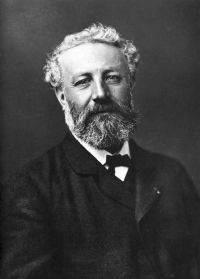
Portrait of Jules Verne Jules Verne 20,000 Leagues Under the Seas… (1870)

Before I had time to express the surprise this new proposition caused me, a camera was carried into the lounge at Captain Nemo's request. The liquid setting, electrically lit, unfolded with perfect clarity through the wide–open panels. No shadows, no blurs, thanks to our artificial light. Not even sunshine could have been better for our purposes. With the thrust of its propeller curbed by the slant of its fins, the Nautilus stood still. The camera was aimed at the scenery on the ocean floor, and in a few seconds we had a perfect negative.
Source: Wikisource

Portrait of Jules Verne Jules Verne 20,000 Leagues Under the Seas… (1870)

Such was the region our Nautilus was visiting just then: a genuine prairie, a tightly woven carpet of algae, gulfweed, and bladder wrack so dense and compact a craft's stempost couldn't tear through it without difficulty. Accordingly, not wanting to entangle his propeller in this weed–choked mass, Captain Nemo stayed at a depth some meters below the surface of the waves.
Source: Wikisource

Portrait of Jules Verne Jules Verne 20,000 Leagues Under the Seas… (1870)

But soon these last representatives of animal life vanished, and three vertical leagues down, the Nautilus passed below the limits of underwater existence just as an air balloon rises above the breathable zones in the sky. We reached a depth of 16,000 meters—four vertical leagues—and by then the Nautilus's plating was tolerating a pressure of 1,600 atmospheres, in other words, 1,600 kilograms per each square centimeter on its surface!
"What an experience!" I exclaimed. "Traveling these deep regions where no man has ever ventured before!
Source: Wikisource

Get perspective with Kwize: daily news enlightened by great literature