Summary

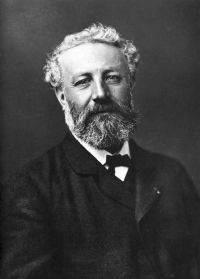
Portrait of Jules Verne Jules Verne Around the Moon — Chapter XIV (1873)

It is the earth, which is thirteen times greater than the diminutive moon that we know-- the earth which developes itself at a diameter of two degrees, and which sheds a light thirteen times greater than that qualified by atmospheric strata-- the earth which only disappears at the moment when the sun reappears in its turn!
Source: Wikisource

Portrait of Jules Verne Jules Verne Around the Moon — Chapter XIV (1873)

What variety we have had, at least in temperature. Now we are blinded with light and saturated with heat, like the Indians of the Pampas! now plunged into profound darkness, amid the cold, like the Esquimaux of the north pole. No, indeed! we have no right to complain; nature does wonders in our honor."
"But," asked Nicholl, "what is the temperature outside?"
"Exactly that of the planetary space," replied Barbicane.
"Then," continued Michel Ardan, "would not this be the time to make the experiment which we dared not attempt when we were drowned in the sun's rays?
Source: Wikisource

Portrait of Jules Verne Jules Verne Around the Moon — Chapter XIV (1873)

Long did the travelers stand mute, watching the constellated firmament, upon which the moon, like a vast screen, made an enormous black hole. But at length a painful sensation drew them from their watchings. This was an intense cold, which soon covered the inside of the glass of the scuttles with a thick coating of ice. The sun was no longer warming the projectile with its direct rays, and thus it was losing the heat stored up in its walls by degrees. This heat was rapidly evaporating into space by radiation, and a considerably lower temperature was the result.
Source: Wikisource

Get perspective with Kwize: daily news enlightened by great literature