Summary

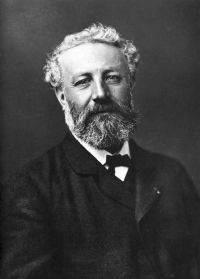
Portrait of Jules Verne Jules Verne Around the Moon — Chapter XV (1873)

Barbicane and Nicholl could not forbear smiling. They had just been creating "art for art's sake." Never had so idle a question been raised at such an inopportune moment. The sinister truth remained that, whether hyperbolically or parabolically borne away, the projectile would never again meet either the earth or the moon.
What would become of these bold travelers in the immediate future? If they did not die of hunger, if they did not die of thirst, in some days, when the gas failed, they would die from want of air, unless the cold had killed them first.
Source: Wikisource

Portrait of Jules Verne Jules Verne Around the Moon — Chapter XV (1873)

It was a reddish incandescence which increased by degrees, a decided proof that the projectile was shifting toward it and not falling normally on the surface of the moon.
"A volcano! it is a volcano in action!" cried Nicholl; "a disemboweling of the interior fires of the moon! That world is not quite extinguished."
"Yes, an eruption," replied Barbicane, who was carefully studying the phenomenon through his night glass. "What should it be, if not a volcano?"
"But, then," said Michel Ardan, "in order to maintain that combustion, there must be air.
Source: Wikisource

Portrait of Jules Verne Jules Verne Around the Moon — Chapter XV (1873)

I allow that the moon, immersed in the sun's rays, will not be visible during the transit, but instead we should see the earth, which would be full. And what is more, if we were drawn round the moon, as at this moment, we should at least have the advantage of seeing the invisible part of her disc magnificently lit."
"Well said, Nicholl," replied Michel Ardan. "What do you think, Barbicane?"
"I think this," answered the grave president: "If ever we begin this journey again, we shall start at the same time and under the same conditions.
Source: Wikisource

Get perspective with Kwize: daily news enlightened by great literature