Summary

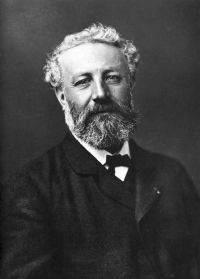
Portrait of Jules Verne Jules Verne From the Earth to the Moon — Chapter XXIV

They had to raise enormous stones, massive pieces of wrought iron, heavy corner-clamps and huge portions of cylinder, with an object-glass weighing nearly 30,000 pounds, above the line of perpetual snow for more than 10,000 feet in height, after crossing desert prairies, impenetrable forests, fearful rapids, far from all centers of population, and in the midst of savage regions, in which every detail of life becomes an almost insoluble problem.
Source: Wikisource

Portrait of Jules Verne Jules Verne From the Earth to the Moon — Chapter XXIV

Would they perceive peoples, herds of lunar animals, towns, lakes, seas? No! there was nothing which science had not already discovered! and on all the points of its disc the volcanic nature of the moon became determinable with the utmost precision.
But the telescope of the Rocky Mountains, before doing its duty to the Gun Club, rendered immense services to astronomy. Thanks to its penetrative power, the depths of the heavens were sounded to the utmost extent; the apparent diameter of a great number of stars was accurately measured
Source: Wikisource

Portrait of Jules Verne Jules Verne From the Earth to the Moon — Chapter XXIV

On the west, however, rise the Rocky Mountains, that immense range which, commencing at the Straights of Magellan, follows the western coast of Southern America under the name of the Andes or the Cordilleras, until it crosses the Isthmus of Panama, and runs up the whole of North America to the very borders of the Polar Sea. The highest elevation of this range still does not exceed 10,700 feet. With this elevation, nevertheless, the Gun Club were compelled to be content, inasmuch as they had determined that both telescope and Columbiad should be erected within the limits of the Union.
Source: Wikisource

Get perspective with Kwize: daily news enlightened by great literature