Summary

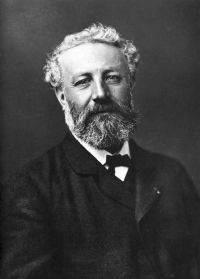
Portrait of Jules Verne Jules Verne Journey into the Interior of the Earth… (1877)

Our raft skirted the whole length of the fuci, three or four thousand feet long, undulating like vast serpents beyond the reach of sight; I found some amusement in tracing these endless waves, always thinking I should come to the end of them, and for hours my patience was vying with my surprise.
What natural force could have produced such plants, and what must have been the appearance of the earth in the first ages of its formation, when, under the action of heat and moisture, the vegetable kingdom alone was developing on its surface?
Source: Wikisource

Portrait of Jules Verne Jules Verne Journey into the Interior of the Earth… (1877)

Ages seem no more than days! I am passed, against my will, in retrograde order, through the long series of terrestrial changes. Plants disappear; granite rocks soften; intense heat converts solid bodies into thick fluids; the waters again cover the face of the earth; they boil, they rise in whirling eddies of steam; white and ghastly mists wrap round the shifting forms of the earth, which by imperceptible degrees dissolves into a gaseous mass, glowing fiery red and white, as large and as shining as the sun.
Source: Wikisource

Portrait of Jules Verne Jules Verne Journey into the Interior of the Earth… (1877)

After a short examination my uncle pronounced his opinion.
"This fish belongs to an extinct family, of which only fossil traces are found in the devonian formations."
"What!" I cried. "Have we taken alive an inhabitant of the seas of primitive ages?"
"Yes; and you will observe that these fossil fishes have no identity with any living species. To have in one's possession a living specimen is a happy event for a naturalist."
Source: Wikisource

Get perspective with Kwize: daily news enlightened by great literature